

Tilton Racing 72-607 Forward Swinging Dual Brake Master Cylinder And Clutch Pedal Assembly


Estimate Shipping
Price: $335.75
2 in stock
Sold As:
1 Pedal Assembly
Part Number: TEE72607
MFG Number:
72-607

 California Prop 65 Warning: This item may cause cancer or reproductive harm. For more info visit p65warnings.ca.gov The above image is a representation of this item. Actual item may vary. If it's crucial to what you're working on, call the store at 951-737-RACE, and one of our sales reps will be happy to email you a current photograph.
 Product Information:
Tilton's 600 series pedal assemblies use traditional fixed mount master cylinders and have a brake balance bar that provides excellent performance at a competitive price.
This pedal assembly shares the same 3" x 7-1/2" bolt pattern as Wilwood's 340-11295 pedal assembly.
For the tandem brake master cylinder pedal, offroad trucks and buggies will have more bias to the rear brakes. 60% rear and 40% front is a common starting point, with a lot of offroad racing vehicles ending up at 30% front and 70% rear. Opposite of a street vehicle.
For the single clutch master cylinder pedal, here is an example of the math. Pushing the clutch pedal with 100 pounds of force, a 6.25:1 pedal ratio and a single 3/4" bore master cylinder:
Pedal force at master cylinder:
100 lbs x 6.25 ratio = 625 lbs
3/4" master cylinder area:
A = π r2
A = 3.14159 x 0.375 x 0.375
A = 0.4418 in2
Line pressure:
625 lbs ÷ 0.4418 in2 ≈ 1415 PSI
This pedal assembly shares the same 3" x 7-1/2" bolt pattern as Wilwood's 340-11295 pedal assembly.
-
Features:
- Uses standard 2-1/4" vertical bolt pattern master cylinders
- Uses 5/16"-24 studs to secure master cylinders
- The clutch pedal heim joint and brake pedal balance bar all use 5/16"-24 push rod master cylinders
- Forged aluminum pedal arms with adjustable (vertical & horizontal) foot pads and grip tape
- Fourteen adjustable pedal ratios (5.94:1 to 7.25:1) enable the brake and clutch pedals to be tuned to driver preference
- Large diameter 7/16"-20 balance bar provides maximum rigidity. PTFE coated aluminum clevises for increased durability and reduced friction
- Pedal pivots feature wave washers to reduce lateral pedal movement and oil impregnated bronze bushings decrease friction
- Lightweight aluminum frame
- Four 5/16" smooth mounting holes on the sides
- Two additional 1/4"-20 threaded holes on the bottom edge near where the master cylinders mount
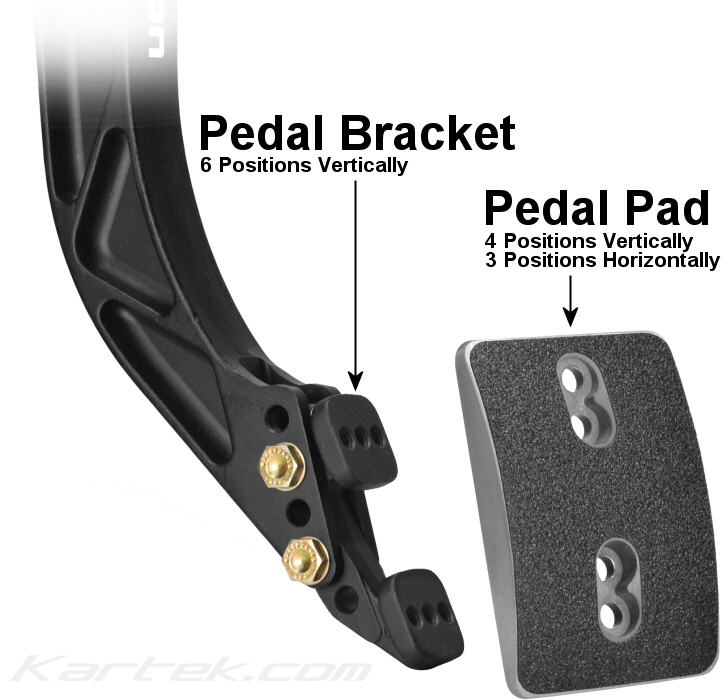
- Pedal pad brackets can be mounted in 3 positions vertically with 7° of forward or 7° of backward tilt
- Pedal pads can be mounted in 4 positions vertically to change pedal ratio
For the tandem brake master cylinder pedal, offroad trucks and buggies will have more bias to the rear brakes. 60% rear and 40% front is a common starting point, with a lot of offroad racing vehicles ending up at 30% front and 70% rear. Opposite of a street vehicle.
For the single clutch master cylinder pedal, here is an example of the math. Pushing the clutch pedal with 100 pounds of force, a 6.25:1 pedal ratio and a single 3/4" bore master cylinder:
Pedal force at master cylinder:
100 lbs x 6.25 ratio = 625 lbs
3/4" master cylinder area:
A = π r2
A = 3.14159 x 0.375 x 0.375
A = 0.4418 in2
Line pressure:
625 lbs ÷ 0.4418 in2 ≈ 1415 PSI
Results
Pedal ratios for this pedal assembly were calculated based on 1.62" from the arm's pivot to the center of master cylinder's push rod. The pedal pad brackets have 4 holes. Sticking with Tilton's requirement of 2 bolts being used that are not adjacent to each other, you end up with 6 vertical positions (3 with short edge down and 3 with long edge down) of the pedal pad bracket and 4 positions of the pedal pad itself (2 with short edge down and 2 with long edge down) which gives you 24 positions that the pedal could be in and roughly 14 different pedal ratios.
Pivot to center of pad divided by pivot to center of master cylinder push rod equals the pedal ratio:
Pivot to center of pad divided by pivot to center of master cylinder push rod equals the pedal ratio:
Pedal bracket short edge down and short pad edge down
Pedal bracket short edge down and long pad edge down
-
Position A
9.625" ÷ 1.62 = 5.94:1
10.000" ÷ 1.62 = 6.17:1
10.375" ÷ 1.62 = 6.40:1
Position B
10.250" ÷ 1.62 = 6.33:1
10.625" ÷ 1.62 = 6.56:1
11.000" ÷ 1.62 = 6.79:1
Pedal bracket short edge down and long pad edge down
-
Position A
10.000" ÷ 1.62 = 6.17:1
10.375" ÷ 1.62 = 6.40:1
10.750" ÷ 1.62 = 6.63:1
Position B
10.375" ÷ 1.62 = 6.40:1
10.750" ÷ 1.62 = 6.63:1
11.125" ÷ 1.62 = 6.87:1
Pedal bracket long edge down and short pad edge down
Pedal bracket long edge down and long pad edge down
-
Position A
10.125" ÷ 1.62 = 6.25:1
10.500" ÷ 1.62 = 6.48:1
10.875" ÷ 1.62 = 6.71:1
Position B
10.625" ÷ 1.62 = 6.56:1
11.000" ÷ 1.62 = 6.79:1
11.375" ÷ 1.62 = 7.02:1
Pedal bracket long edge down and long pad edge down
-
Position A
10.500" ÷ 1.62 = 6.48:1
10.875" ÷ 1.62 = 6.71:1
11.250" ÷ 1.62 = 6.94:1
Position B
11.000" ÷ 1.62 = 6.79:1
11.375" ÷ 1.62 = 7.02:1
11.750" ÷ 1.62 = 7.25:1
Related Parts
Tilton Racing 72-615 Spring Loaded Forward Swinging Throttle Pedal Assembly With Pedal Stops

In Stock
Price: $229.50
Wilwood 340-11295 Forward Swinging Dual Brake Master Cylinder And Clutch Pedal Assembly

In Stock
Price: $301.36


Tilton Racing 72-561 Remote Bias Adjuster 90 Degree Adapter For 7/16"-20 Thread Balance Bars

In Stock
Price: $93.50


monit Tab Mount Black Brake Pedal Digital Bias Adjuster Knob Works On 3/8" Or 7/16" Balance Bars

In Stock
Price: $329.00


EBBCO Offroad Ultralight Weight Dimple Died Carbon Fiber Driver Left Foot Rest Dead Pedal

In Stock
Price: $67.79
Kartek Off-Road Driver Left Foot Rest Dead Pedal With Heel Stop And Adjustable Angle

In Stock
Price: $114.99
Alpha Waterjet Cutting 3 Bolt Pattern Weld Together Stainless Steel Left Foot Rest Dead Pedal

In Stock
Price: $210.00
Tilton Racing 73-750 Aluminum Tall Rectangular 3/4" Bore Clutch Or Brake Master Cylinder

In Stock
Price: $69.70
Tilton Racing 73-875 Aluminum Tall Rectangular 7/8" Bore Brake Master Cylinder
In Stock
Price: $69.70



Tilton Racing 76-625 Aluminum 5/8" Bore Clutch Or Brake Master Cylinder For Remote Reservoir

In Stock
Price: $123.25
Tilton Racing 76-750 Aluminum 3/4" Bore Clutch Or Brake Master Cylinder For Remote Reservoir
In Stock
Price: $123.25
Tilton Racing 76-812 Aluminum 13/16" Bore Brake Master Cylinder For Remote Reservoir
In Stock
Price: $123.25
Tilton Racing 76-875 Aluminum 7/8" Bore Brake Master Cylinder For Remote Reservoir
In Stock
Price: $123.25
Tilton Racing 76-1000 Aluminum 1" Bore Brake Master Cylinder For Remote Reservoir
In Stock
Price: $123.25


Wilwood 260-6764 Aluminum Tall Rectangular 3/4" Bore Clutch Or Brake Master Cylinder

In Stock
Price: $76.58

